
Big changes are rolling out across Singapore’s education system—from national exams in secondary school to entry requirements for Junior Colleges. Here’s a clear breakdown of what’s coming and why it matters to students and parents:
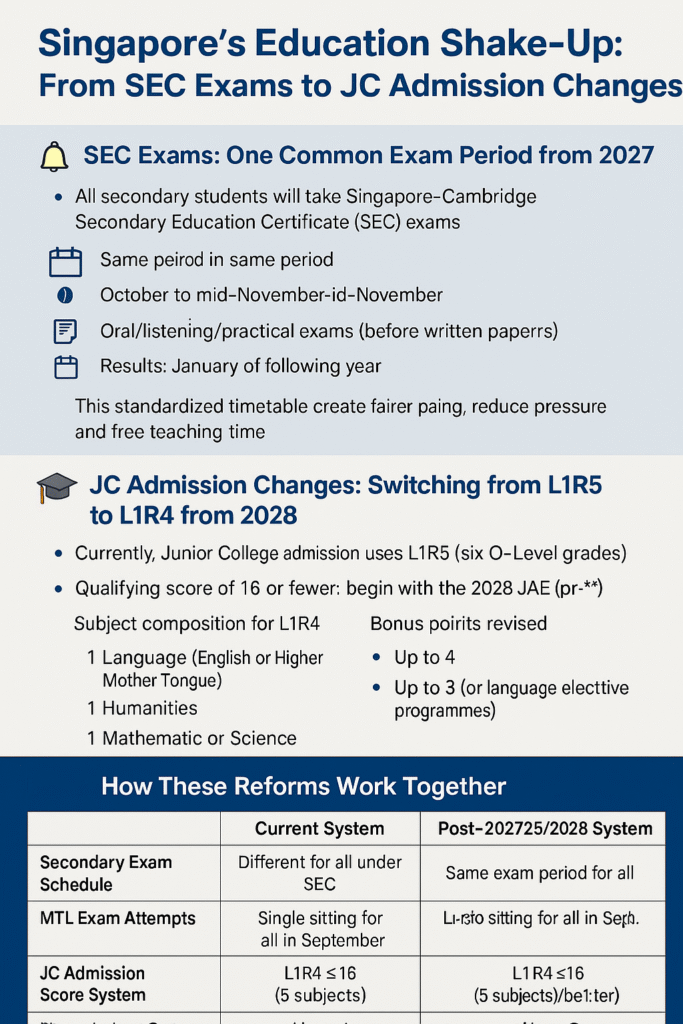
📘 1. SEC Exams: One Common Exam Period from 2027
What’s changing?
From 2027, all secondary school students will take their Singapore‑Cambridge Secondary Education Certificate (SEC) exams in the same exam period, regardless of whether they’re in Express, Normal (Academic), or Normal (Technical). Subject levels (G1, G2, G3) are now based on ability, not stream.
Students will take:
- English & Mother Tongue papers in early September
- Other subjects between October and mid-November
- Oral, listening, practical exams beforehand
- Results for everyone will be released in January of the following year.
Why it matters:
This standardised timetable creates fairer pacing, reduces exam pressure, and frees up teaching time—especially for Mother Tongue learning.
🎓 2. JC Admission Changes: Switching from L1R5 to L1R4 from 2028
Current system:
Junior College admission currently uses L1R5—an aggregate of six O‑Level grades—where students must score 20 points or fewer to qualify.
What’s new?
From the 2028 Joint Admissions Exercise (JAE), MOE will use L1R4, counting only five subjects. The qualifying score is tightened to 16 points or better.
Subject composition for L1R4:
- 1 Language (English or Higher Mother Tongue)
- 1 Humanities subject
- 1 Mathematics or Science
- 1 additional subject from Humanities, Math, or Science
- 1 best remaining subject (instead of two for L1R5)
Bonus points revised:
Bonus point cap reduced from 4 to 3, but students in Chinese, Malay, or Tamil Language Elective Programmes can still earn up to 5 points.
Why MOE made this shift:
The change supports a shift toward holistic education, giving students more flexibility to focus on strengths, reduce load, and engage more in CCAs.
MOE also views students today as better prepared—A-Level passing rates have risen from ~65% in 1990 to ~95% in 2023—and fewer subjects needed still ensure a strong academic foundation.
🧩 3. How These Reforms Work Together
| Feature | Current System | Post-2027/2028 System |
|---|---|---|
| Secondary Exam Schedule | Different for different streams | Same exam period for all under SEC |
| MTL Exam Attempts | 2 chances for O-Level only | Single sitting for all in September |
| JC Admission Score System | L1R5 ≤ 20 (6 subjects) | L1R4 ≤ 16 (5 subjects) |
| Bonus Points Cap | Up to 4 | Up to 3 (plus 2 for language elective programmes) |
| Admission subject levels | G3 only for admission | G3 only (L1R4 uses only G3 subjects) |
✅ What Parents & Students Should Do Now
- Understand Full SBB (Subject Based Banding): Focus on subject strengths (G1–G3 choices), not the Express/N‑stream labels.
- Plan judiciously: For O‑Levels, target quality over quantity—especially given the new L1R4 system.
- Explore interests beyond academics: Expect extra time for CCAs and personal development thanks to reduced subject load.
- Stay informed: These reforms apply to first participating cohorts: students taking Secondary 1 in 2024 (SEC exams in 2027) and Secondary 2 in 2026 (JC entry in 2028).